


The iconic Piedmontese Tajarin
Once in Torino or any other city of Piemonte you can't go without trying these thin hand made noodles
1/16/20262 min read

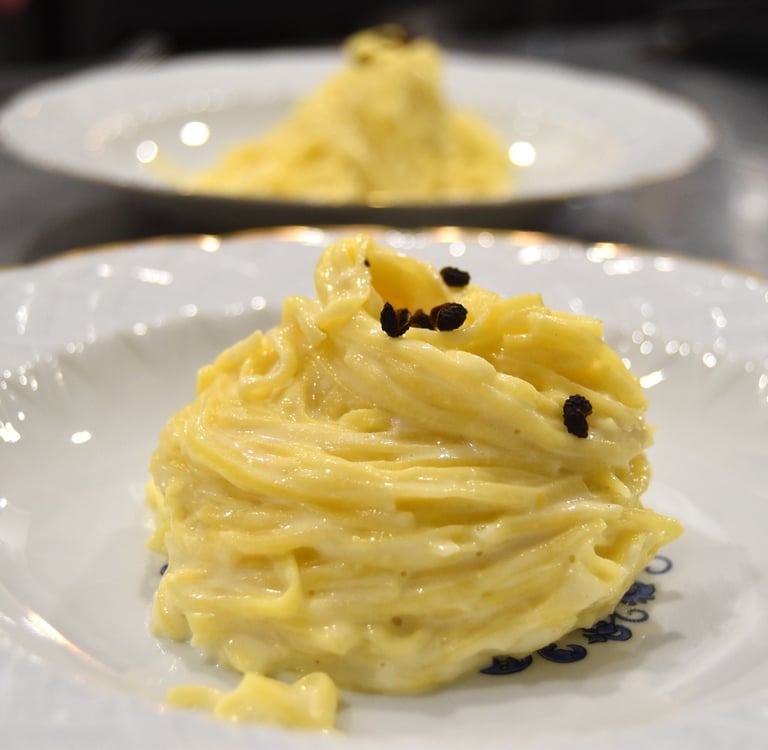
As with every Italian culinary tradition, the famous Piedmontese Tajarin have been subjected to many, and sometimes very different, interpretations. According to the most widely accepted recipes, including those of local food and wine historians, only egg yolks should be used, while others prefer to use egg whites as well. Some also claim that the amount of egg yolks per kilogram of flour is 40! This is a truly significant number, and it explains why Piedmontese Tajarin, unlike many other Italian egg pasta, are more colorful, more "yellow." Nowadays, however, most restaurants, even those most attentive to tradition and the most observant enthusiasts of Piedmontese cuisine, use a lower number of eggs (or yolks), both to keep the cost down and to make the Tajarin lighter and more digestible.
About the flour, a distinction must also be made: in some areas of Italy only semolina flour is used, in others only soft wheat flour, and in still in others a mixture of the two, with different proportions depending on the desired elasticity of the dough.
As you can imagine, providing a standard recipe that satisfies everyone is truly impossible (as with any other Italian culinary specialty, to be honest), and whichever version you stick to, you must accept the risk of exposing yourself to praise from some and criticism, even harsh ones, from others. Therefore, I'll defend myself by providing you with the recipe that my mother left me, and that my grandmother passed down to her. It's nothing that can be labeled "traditional," but simply one of the many homemade versions of a traditional dish from Turin and Piedmont. Try it and let me know what you think. Ultimately, what matters is the result.
Ingredients:
300 g of type 00 flour
200 g of semolina flour
6 eggs
20 g of oil
Directions
After mixing the two flours, make a well on a work surface. Crack the eggs into the center, add a pinch of salt and the oil. Then, very gently, using your fingertips, incorporate the flour into the eggs, working from the outside in. Once the eggs have absorbed all the flour, knead vigorously with your hands until the dough is smooth and homogeneous. Cover with plastic wrap and let it rest in the refrigerator for about 15 minutes to allow the gluten to weaken.
Using a pasta machine, roll out the dough very thinly. Dust with flour and roll each sheet up, then cut it into fairly thin strands with a knife, forming long, thin strips of pasta.